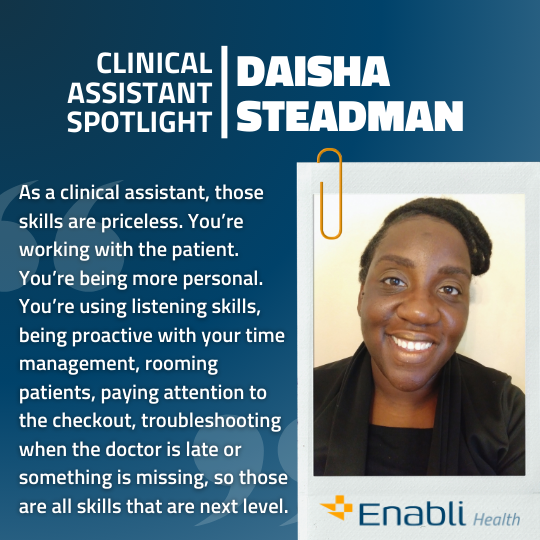
When Daisha first stepped into healthcare, she wasn’t sure exactly where it would take her. A biology major in college, she considered medical school and even worked as an EMT. Over time, her path shifted into teaching, and she spent several years as a high school biology teacher. Life changes, including marriage, motherhood, and a cross-country move, eventually led her back to healthcare.
After some time at home with her daughter, Daisha returned to the medical field part-time as a Medical Scribe within an Emergency Department with ScribeAmerica, our sister company. As her daughter grew older, Daisha knew she was ready for something more, ideally something more hands-on. That opportunity came when she transitioned into a Clinical Assistant role with Enabli Health.
Daisha works in a busy urology practice with multiple providers and locations. As a clinical assistant, Daisha rooms patients, takes vitals, gathers medical information, runs urine tests, prepares charts for providers, and more.
Beyond clinical tasks, Daisha sees her role as deeply human. Many urology patients arrive anxious and uncomfortable. She recognizes that she is often the first clinical team member they interact with beyond the front desk.
“I’m bringing them to the room. I’m helping calm them down. I’m explaining just in general what to expect,” she said.
For all patients, those small moments of connection matter. Daisha uses her natural friendliness to help ease whatever the patient is going through.
Even though Daisha is new to her Clinical Assistant role, she’s already an essential part of the care team.
“Even though I cannot do some of the advanced skills, I still feel like I’m taking one less task off of one of my seasoned colleagues,” she said. “I still feel essential.”
That sense of purpose drives her daily work. The providers she works with often split their days between clinic and surgery, moving quickly to stay on schedule. By ensuring patients are ready and information is accurate before the provider enters the room, Daisha helps keep the day running smoothly.
“I really feel that I’m useful even being new,” she said. “Because I’m that frontline person, I’m able to gather and give the doctor a heads up.”
She recalls a patient who came in for kidney stones and had already passed the stone before the visit. Because she had gathered that information early, the provider was able to immediately order a stone analysis.
Recently, Daisha began phlebotomy training. After completing instructional modules, she practiced on a training arm before attempting her first real blood draw.
“[The training arm is] nothing like doing it for real,” she said, recalling the first time she held the needle. “Am I going to be gentle enough? Am I going to know the right amount of pressure?”
Within a few days, she successfully drew blood from her trainer, and again with a coworker. “I’m seeing the progression in real time,” she said.
She views the new skill as another way to support her team. By handling her standard clinical tasks and blood draws, she frees up more time for the more experienced members of the medical team to focus on specialized procedures.
For anyone who wants to work in healthcare but is not necessarily pursuing medical school, she encourages them to consider a Clinical Assistant role. It builds skills, confidence, and the ability to think on your feet. It also gives you a real connection with patients.
As for the future, Daisha is currently happy where she is. She enjoys Urology and the steady need for the specialty.
“I like Urology,” she said. “Because I look at it as no matter what, anyone can potentially have a urinary issue, old or young, black or white, woman or man.”
She plans to keep improving her phlebotomy skills, continue supporting her team, and step in wherever she is needed. For her, fulfilment comes from showing up each day, doing the work well, and helping patients feel just a little more at ease.